Free tool · UK imports · official UK MOT data
Free UK MOT History Check by VIN for cars imported into Ireland
Enter the VIN of a car that came from Britain and see every MOT test it took there — pass or fail, every advisory, and the odometer reading at each test, converted to km. You don't need the UK registration, there's no signup, and it costs nothing.
Free · no signup · enter the VIN, or the old UK registration if you have it
Example result
VAUXHALL ADAM
UK record found
8 UK MOT tests, 2019–2025
Last UK MOT on 6 November 2025 — passed. No recorded mileage reading went down between tests.
VIN
•••••••••••••••••
Make
VAUXHALL
Model
ADAM
Colour
White
Fuel
Petrol
First used
18 October 2016
Engine
999 cc
UK MOT tests
8
Check these against the car and its Vehicle Registration Certificate. A different make, model or colour is a reason to stop and ask — it can mean a typing slip, a respray, or a car wearing another car's identity.
Mileage at each UK MOT
The odometer reading the UK test station logged at every MOT, converted to kilometres. UK readings are recorded in miles, so the original is shown beside each one.
| UK MOT | Odometer | Change |
|---|---|---|
| 10 October 2019 | 28,954 km (17,991 miles) | — |
| 2 October 2020 | 35,077 km (21,796 miles) | +6,124 km |
| 7 October 2021 | 41,508 km (25,792 miles) | +6,431 km |
| 7 October 2021 | 41,508 km (25,792 miles) | +0 km |
| 14 October 2022 | 51,356 km (31,911 miles) | +9,848 km |
| 16 October 2023 | 59,013 km (36,669 miles) | +7,657 km |
| 25 October 2024 | 69,593 km (43,243 miles) | +10,580 km |
| 6 November 2025 | 80,623 km (50,097 miles) | +11,030 km |
About 8,500 km a year between the first and last UK MOT. The last UK reading was 80,623 km (50,097 miles) on 6 November 2025. The odometer today should read more than that — if it reads less, stop and ask why.
Can I check a UK import's MOT history without the UK registration?
What the free UK history check shows
- The registration it had in the UK — useful in itself, and the key to GOV.UK's own services if you want to look further.
- Make, model, colour, fuel and engine size as the UK record holds them, to compare against the car and its Irish paperwork.
- Every UK MOT test on the computerised record, which starts in 2005 — the date and whether it passed or failed.
- Failures and advisories in the tester's own words, and which of them were still open at the last UK test.
- The odometer reading at every test, converted to km with the original miles beside it, and a warning if any reading went down.
- An outstanding recall, where the UK record shows one.
It does not show finance, write-off or theft markers, Irish NCT results, or the car's service history. Those are different records, held by different people.
DVLA reg check or UK number plate check — from Ireland
Most Irish searches for a “DVLA reg check” are about exactly this: a car that came from Britain, and what its British record says. GOV.UK has two free services for it, and both take the UK registration. The DVLA's vehicle enquiry service shows whether a car is taxed and has a current MOT in the UK, which stops meaning anything once the car is on Irish plates. The DVSA's MOT history service shows the test record, which is the part that still matters.
The tool on this page reads that same DVSA record, by VIN, so you don't need the old plate. If you do have it — on the V5C the seller holds, or on the British plates — you can enter it instead. A current Irish registration won't work: Irish plates aren't on the UK record.
We are an independent service, not part of the DVLA, the DVSA or any Irish authority. The data is the UK government's; we display it, free.
Why this matters more in Ireland than anywhere else
Irish used-car demand has outrun Irish supply for years, and the gap is filled with imports. According to SIMI, Ireland registered 71,813 imported used cars in 2025, up 16.6% on 2024. Through the first seven months of 2026 the figure was 55,724 — running 37% ahead of the same period a year earlier.
Japan is now the largest single source — a Japanese import has no British record, and we cover those on the imported car service history page. But Britain still sends Ireland thousands of used cars a year, and every one of them carries a public record from its time there.
And here is the asymmetry: Irish NCT history is not published. You cannot look up the NCT record of a car you are thinking of buying. But a car that spent its life in Britain has a public MOT history — free, complete, and available in seconds by VIN.
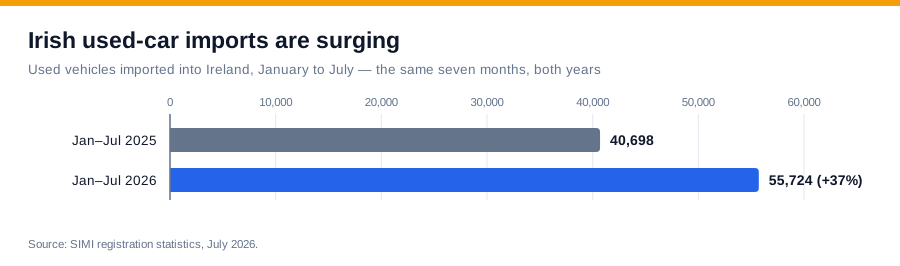
For the largest single category of car on the Irish used market, there is more free history available than for a domestic Irish car. Most buyers never read it. Not every import came from Britain, though — if the check finds nothing, the car most likely never ran there, and there is no UK record to read.
One in 86 UK cars has a mileage reading that goes backwards
We analysed the MOT records of 3,350 UK vehicles — the same population Ireland imports from — looking at the odometer reading recorded at each test. A car's mileage should only ever increase. A later reading below an earlier one means a rollback, a cloned identity, or a replaced instrument cluster.
Counting only drops of more than about 1,600 km (1,000 miles), so data-entry noise is excluded, 1.2% of cars — one in 86 — show one. Where it happens, the median amount erased is about 26,800 km (16,634 miles).
The rate rises steeply with age, which matters because imports skew older than the domestic fleet:
| Age of car | Vehicles examined | Mileage goes backwards |
|---|---|---|
| Up to 5 years | 528 | 0.2% |
| 6 to 10 years | 1,934 | 1.0% |
| 11 to 15 years | 777 | 1.9% |
| 16 years and over | 111 | 2.7% |
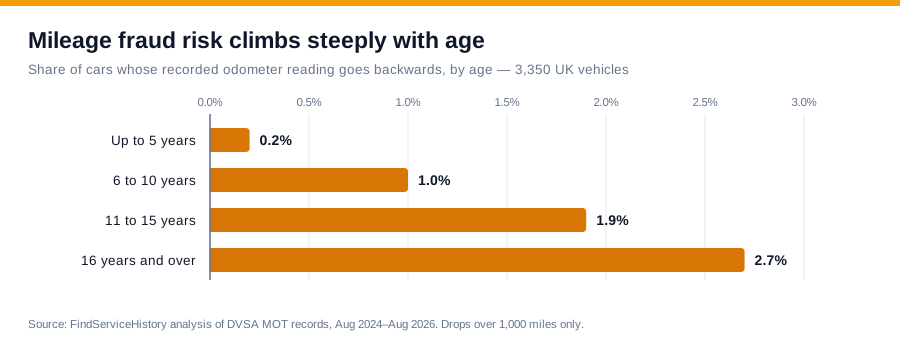
A fifteen-year-old car is more than ten times as likely to carry a mileage discrepancy as a five-year-old one. If you are buying at the older, VRT-efficient end of the import market, this is the check to run first — and it costs nothing. The tool flags a drop automatically and shows every reading in km, so you can also compare the last UK reading with the odometer in front of you.
The MOT record also tells you what the car is about to need
Mileage is the headline, but the advisory list is the part that saves money. An advisory is a defect the tester noticed that was not yet bad enough to fail. Irish buyers routinely dismiss them. They should not.
Across every consecutive pair of tests in our sample, we asked how often an advisory became a failure in the same category at the very next test:
- Axles, wheels, tyres and suspension — 10.1%. One in ten becomes a failure within a year.
- Brakes — 5.9%
- Steering — 5.8%
- Lamps and electrical — 5.2%
Suspension and tyre advisories on the last British MOT are a bill with a date on it — and in Ireland that bill arrives at the first NCT, after you have already paid the VRT. The tool lists what was still open at the last UK test, and anything flagged two years running.
Where the free record runs out
The MOT history is a roadworthiness trail, not a maintenance record. It will not tell you whether the oil was changed on schedule, whether the cambelt was done, whether a DPF was replaced, or whether the car has seen a franchised dealer in a decade. A car can hold a spotless MOT record and have no service history at all.
That gap is worth quantifying. In a separate analysis of 3,815 UK MOT tests on cars where we also hold the manufacturer's service record, a documented dealer service in the previous twelve months was associated with an 11.0% failure rate on cars aged four to nine, against 15.6% where none was recorded — a reduction of just under a third. On cars under four there was no difference at all.
So for a young import, the service record says relatively little about imminent roadworthiness. For the six-to-nine-year-old cars that dominate Irish imports, it is one of the better predictors available — and unlike the MOT record, it doesn't stop at the border. The manufacturer's record is keyed to the VIN and follows the car into Ireland unchanged. Ours costs €12.99, and nothing if no records are found.
How to check an import properly, in order
- Get the VIN. It is in field E of the Vehicle Registration Certificate, at the base of the windscreen on the driver's side and on the door frame. You don't need the old UK registration.
- Read the full UK MOT history free, with the tool at the top of this page. Check every odometer reading in order — any drop is a stop-and-ask moment — then read the advisories on the last two tests.
- Check the odometer against the record, not the seller. The car should show more than its last UK reading. A clocked car has a plausible dashboard; it rarely has a plausible ten-year MOT trail.
- Then check the service history by VIN. This is the part the free record cannot give you — the manufacturer's own dealer entries, with dates, mileages and work done, for €12.99.
- Only then work out the VRT. Import costs are fixed and knowable. Condition is not, and it is where the money is actually lost.
Method and reuse
The research figures on this page come from UK vehicle lookups run through FindServiceHistory between August 2024 and August 2026: 25,896 DVSA MOT tests across 3,350 vehicles, every one with two or more recorded odometer readings. Distances are converted from the miles the UK record uses. Import volumes are SIMI registration statistics. No personal data, registration or VIN is used in, or recoverable from, any figure published here.
Journalists, dealers and forum members are welcome to quote any figure on this page with attribution to FindServiceHistory and a link back. If you need a cut we have not published, ask us.
FAQ
Frequently Asked Questions
Is the UK MOT history check free?
Yes. It reads the UK government's MOT database, which we can query free of charge, so there is no signup, email or card. You get every UK MOT test with its result and advisories, and the odometer reading at each test in km with the original miles. The service history check is a separate paid product you never have to buy to use it.
Do I need the car's UK registration?
No. The UK MOT record is held against the VIN as well as the plate, so the 17-character VIN from field E of the Vehicle Registration Certificate is enough. If you do have the old UK registration, from the V5C or the British plates, you can enter that instead. The car's current Irish registration won't work, because Irish plates aren't on the UK record.
Why does my VIN show no UK MOT record?
Usually because the car never ran in Great Britain: it was sold new in Ireland, or imported from Japan or mainland Europe. A car that left the UK before it was three years old will be on the record with no MOT tests, because the first MOT in Great Britain is due at three years old. Otherwise, check the VIN for a typo against field E of the Vehicle Registration Certificate.
Is this the DVLA or DVSA website?
No. FindServiceHistory is an independent service and is not connected to the DVLA, the DVSA or any Irish authority. The MOT data is the UK government's; we look it up by VIN and display it free. GOV.UK's own vehicle enquiry and MOT history services are also free, and both take the UK registration.
Are the mileages in miles or kilometres?
UK MOT readings are recorded in miles. We convert each one to kilometres and show the original reading beside it, so you can compare it directly with an Irish odometer and still see exactly what the UK record says.
How common are clocked cars among UK imports?
In our analysis of 3,350 UK vehicles, 1.2% — about one in 86 — had an odometer reading that went backwards by more than about 1,600 km (1,000 miles) between MOT tests. That rises to 1.9% on cars aged 11 to 15 and 2.7% on cars over 16. Because imports skew older than the domestic Irish fleet, the practical risk on an import sits towards the higher end of that range.
Does the NCT record show previous mileage in Ireland?
Mileage is recorded at the NCT, but there is no public NCT history lookup for a car you do not own, so you cannot use it to verify a seller's claims. That is why the British record on an import is so valuable — it is the mileage trail you can actually read.
Does a car's service history transfer when it is imported?
Yes. The manufacturer's digital service record is attached to the VIN, and the VIN does not change when a car is imported and re-registered in Ireland. Work done at a franchised dealer in Britain is still retrievable once the car is on Irish plates.
Is a UK import a worse buy than an Irish car?
Not inherently — and it comes with more free history than a domestic car does. The risk is not that imports are worse cars, it is that buyers check them less carefully because the paperwork feels unfamiliar. Read the UK MOT record by VIN and that risk drops sharply.
Related
More for UK imports
Then check the service history by VIN
The UK MOT record shows how the car tested. The manufacturer's dealer records show how it was looked after — and they follow the VIN onto Irish plates. €12.99, and nothing to pay if no records are found.
Check service history — €12.99